For decades, the global automotive industry paid a silent tax to legacy Tier-1 giants like Bosch, Continental and Delphi.
Every time an engine had to start, synchronize, run smoothly or pass an emission test, vehicle makers depended on complex physical hardware: sensors, wiring, copper, plastic and control modules buried inside one of the harshest environments in engineering.
Heat. Dust. Vibration. Moisture. Failure.
That was the old automotive order.
Then SEDEMAC Mechatronics asked a dangerous question:
What if the sensor itself could disappear?
Born out of deep engineering research at IIT Bombay, SEDEMAC did not try to build a stronger physical sensor. It attacked the problem at the root. The company converted a hardware problem into a software problem.
By embedding advanced mathematical algorithms into low-cost microchips, SEDEMAC built systems that could track engine behavior by reading electrical signals. Instead of depending entirely on fragile physical sensors, its software could infer what was happening inside the engine in real time.
That single shift changed the economics of automotive electronics.
Less hardware. Lower complexity. Better reliability. More software value.
And because the company protected this architecture through patents, SEDEMAC did not merely create a product. It created a moat.
But the real SEDEMAC story is not just about deleting one sensor.
That was only the ignition.
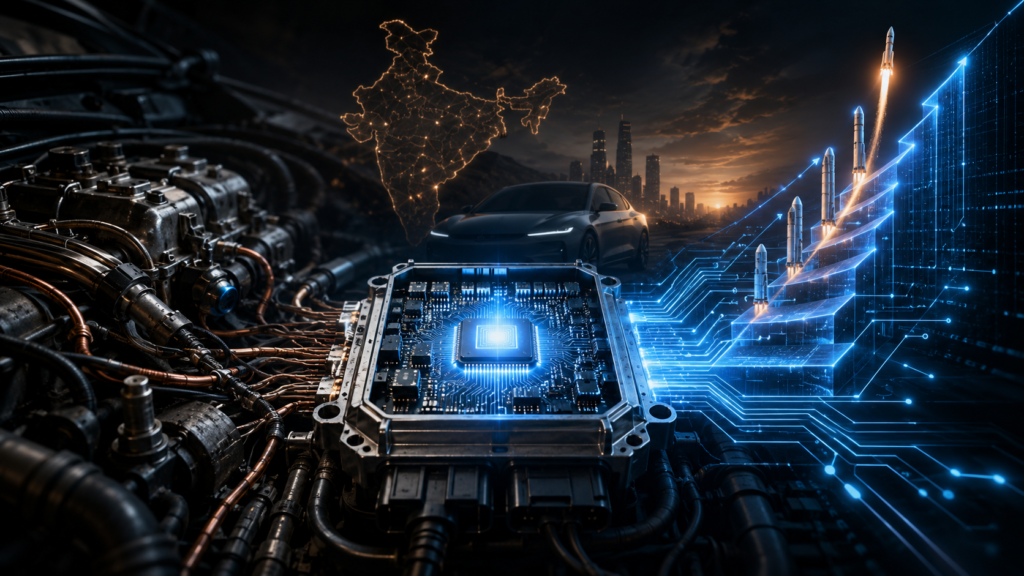
The deeper story is that SEDEMAC has built a product rocket: one growth booster after another, each increasing the company’s content per vehicle.
This is not a linear auto-ancillary story.
This is a layered control-electronics story.
What SEDEMAC Mechatronics Actually Does
SEDEMAC Mechatronics designs and manufactures control-intensive electronic systems for vehicles and equipment.
In simple terms, it builds the electronic brains that help engines, motors and powertrains behave intelligently.
Its product portfolio spans both internal combustion engine platforms and electric powertrains. On the ICE side, SEDEMAC works on sensorless integrated starter generators, fuel-injection ECUs, ISG + EFI systems and ignition-control products. On the electric side, it offers motor controllers, traction motors and related powertrain-control products.
This mix is important.
Many auto-component companies are trapped in one technology cycle. If the market shifts from petrol to electric, their business can get disrupted. SEDEMAC is different because its core strength is not one mechanical part. Its core strength is control.
Whether the vehicle uses petrol, ethanol, diesel or electricity, it still needs electronic intelligence.
That is the real moat.
The Core Breakthrough: Sensorless Control
The starting point of SEDEMAC’s story is sensorless control.
Traditional engine and motor systems use physical sensors to detect position, speed or movement. These sensors add cost, wiring, complexity and failure points. In harsh vehicle environments, that becomes a serious problem.
SEDEMAC’s sensorless control technology reduces this dependence on physical sensing hardware. It uses electrical feedback and embedded algorithms to estimate what is happening inside the engine or motor.
This is why the technology matters.
If a company can remove hardware and replace it with software, it changes the cost structure. If it can do that reliably at scale, it changes the supplier power equation.
That is why SEDEMAC’s sensorless technology is more than an engineering trick.
It is the first crack in the old automotive electronics model.
TVS Motor: The First Real-World Validation
Brilliant technology means nothing in the automotive world unless it survives the road.
Automakers are conservative for a reason. A failed component can damage reputation, trigger recalls and destroy customer trust. No major manufacturer wants to be the first to gamble on unproven electronics inside a mass-market vehicle.
That is why TVS Motor became the critical ignition customer.
For years, TVS acted as SEDEMAC’s real-world proving ground. Across millions of kilometers of Indian roads, the company’s sensorless technology was tested through heat, rain, dust, vibration, traffic and abuse.
This was not laboratory validation.
This was survival validation.
Once TVS proved the technology at scale, the biggest risk in SEDEMAC’s business model began to collapse. The company was no longer selling a theory. It was selling a field-tested platform.
The first burner had fired.
Bajaj and Hero: From Single Customer to Multi-OEM Scale
Once the technology was proven, the adoption curve changed.
Other large two-wheeler manufacturers did not need to wait through the same long incubation cycle. Companies such as Bajaj Auto and Hero MotoCorp could evaluate and integrate SEDEMAC’s electronic control units with far greater confidence.
This changed the structure of the company.
SEDEMAC moved from single-customer dependency toward a multi-anchor OEM model. That matters because in automotive electronics, customer concentration is one of the biggest risks. Once multiple high-volume OEMs adopt the platform, the business becomes deeper, stickier and harder to displace.
The result was a major revenue inflection.
SEDEMAC was no longer a niche deep-tech supplier attached to one large customer. It was becoming a core electronics partner to India’s two-wheeler industry.
But even this is only the beginning.
The bigger story is not just more customers.
The bigger story is more content per vehicle.
The Product Rocket: Each Block Raises Content Per Vehicle
SEDEMAC’s growth model is powerful because each product is a separate story waiting to unfold.
A basic sensorless starter product is one story.
Electronic fuel injection is another.
ISG + EFI is another.
E85 and E100 flex-fuel control is another.
Four-wheelers and light commercial vehicles are another.
EV motor controllers are another.
Traction motors are another.
Battery health software is another.
Each new product block acts like a booster attached to the same rocket. The company does not need to depend only on vehicle volume growth. It can also grow by capturing more electronics inside every vehicle.
That is called content per vehicle.
And for SEDEMAC, content per vehicle is the main compounding engine.
Booster 1: From SLC to ISG
The first booster is the move from sensorless control to Sensorless Integrated Starter Generators.
A conventional vehicle usually needs a starter motor to crank the engine. SEDEMAC’s ISG approach eliminates the traditional starter motor system and enables smoother, quieter and more reliable starts.
This is not just a comfort feature.
It changes the vehicle architecture.
ISG can support silent starts, idle start-stop and torque assist. For OEMs, that means a cleaner user experience and a more modern vehicle without adding unnecessary mechanical complexity.
For SEDEMAC, it means the company is not merely selling a small electronic part.
It is controlling a critical start-stop function inside the vehicle.
That is the first content step-up.
A sensorless control idea becomes an integrated starter-generator control system.
Booster 2: From ISG to ISG + EFI
The next booster is integration.
SEDEMAC’s product portfolio includes ISG + EFI systems, combining Integrated Starter Generator control with Electronic Fuel Injection functionality.
This is where the business starts to become more interesting.
EFI is central to modern engine performance, fuel efficiency and emission compliance. It manages fuel injection and helps the engine operate properly across different conditions. In small petrol engines, EFI enables control of one- and two-cylinder engines while meeting emission requirements and maintaining performance.
Now combine that with ISG.
Instead of selling one control unit for starting and another control unit for fuel injection, SEDEMAC can integrate more functionality into a single electronic architecture.
That increases content per vehicle.
It also simplifies the vehicle for the OEM.
Less duplication. Fewer components. Cleaner harnessing. More software value.
This is the first major proof that SEDEMAC is not selling isolated boxes. It is building a control platform.
Booster 3: E85 and E100 Flex-Fuel Electronics
The next booster is ethanol.
As the market moves toward higher ethanol blends such as E85 and E100 flex-fuel platforms, engine control becomes much more complex.
Ethanol does not behave like petrol. It has different combustion characteristics, different cold-start behavior and different fuel quantity requirements. A flex-fuel engine needs smarter calibration because the ECU must continuously manage changing fuel composition, temperature, air-fuel ratio and engine load.
This is where SEDEMAC’s software-heavy model becomes more valuable.
Basic fuel injection is one level of control.
Flex-fuel control is a higher level.
As regulation pushes the industry toward cleaner fuels, OEMs will need more sophisticated electronic control systems. That means more software, more calibration, more sensors or sensorless estimation, and more intelligence inside the ECU.
For SEDEMAC, E85 and E100 are not just fuel stories.
They are content-per-vehicle stories.
The same vehicle platform can carry a richer electronic stack. That allows SEDEMAC to earn more from every chassis even if the number of vehicles sold does not grow at the same speed.
This is the beauty of the model:
Regulation forces digitization.
Digitization raises electronic content.
Higher electronic content expands SEDEMAC’s revenue opportunity per vehicle.
Booster 4: Four-Wheelers and LCV Aftertreatment
The next booster is four-wheelers and light commercial vehicles.
This is where SEDEMAC begins moving from small-engine dominance into more premium automotive territory.
Two-wheelers offer volume.
Commercial vehicles offer value.
Light commercial vehicles, diesel platforms and fleet vehicles operate for long hours, carry payloads and face strict emission requirements. Their electronics must manage not just engine performance, but also aftertreatment systems, diesel emission control and regulatory compliance.
This is the gateway into Bosch’s traditional profit pool.
Aftertreatment Control Modules are critical in modern diesel vehicles. They manage systems such as urea dosing, AdBlue injection, particulate filters and emission-compliance hardware.
These are not low-value parts.
They sit inside mission-critical systems where reliability is non-negotiable. A failure can affect compliance, vehicle uptime and fleet economics.
That gives the electronics supplier a different kind of pricing power.
Even small market-share wins in four-wheelers and LCVs can become meaningful because the content per vehicle is structurally higher than in basic two-wheeler electronics.
This is where SEDEMAC stops looking like only a two-wheeler electronics company.
It starts looking like a serious challenger to the global automotive electronics establishment.
Booster 5: EV Motor Controllers
The electric vehicle opportunity is even more powerful because the entire vehicle becomes an electronic machine.
In an internal combustion vehicle, SEDEMAC may control ignition, fuel injection or starter-generator functions. In an EV, the company can move much deeper into the vehicle brain.
The motor controller is one of the most important parts of an electric powertrain. It decides how power flows from the battery to the motor. It manages torque, speed, efficiency, thermal limits, braking energy recovery and fault protection.
In simple words, it controls how the EV moves.
SEDEMAC’s electric powertrain portfolio includes a wide range of ISAAC motor controllers. These controllers sit at the heart of EV propulsion. Their functions include motor control, regenerative braking, battery-current limitation, diagnostics, thermal protection and operating-mode management.
This is not a small add-on.
This is a major content jump.
Instead of selling one control unit into an ICE platform, SEDEMAC can sell a broader EV powertrain-control layer.
The vehicle no longer needs only a starter brain.
It needs a propulsion brain.
Booster 6: Traction Motors
The next EV booster is the traction motor.
A motor controller is powerful. But when a company can pair the controller with the motor itself, the value proposition becomes stronger.
SEDEMAC’s portfolio includes traction motors such as Stark S, Logan 2000 and Logan 3500. These products show that the company’s EV ambition is not limited to electronics alone. It is moving toward a more integrated electric powertrain stack.
This matters because EV OEMs want reliability, efficiency and smoother integration. If the controller and motor are designed to work together, the supplier can offer a more complete system rather than a standalone component.
That increases content per vehicle again.
In an ICE vehicle, SEDEMAC may sell a specific control product.
In an EV, it can potentially participate in the motor controller, motor and software layer together.
That is why EVs can multiply the company’s revenue opportunity per chassis.
Booster 7: Battery Health Software
The final booster is battery intelligence.
In an electric vehicle, the battery is the most expensive and sensitive component. Fleet owners, OEMs and customers all care about battery life, safety, charging behavior and degradation.
This creates a natural software opportunity.
A company that already understands motor control, current limits, temperature estimation and diagnostics is well placed to build deeper battery-health intelligence.
Battery health software can monitor performance, detect stress, estimate degradation and improve operating reliability.
This is valuable because battery health is not just a technical feature.
It is an economic feature.
A better battery-health system can reduce warranty risk, improve resale value, protect fleet uptime and increase customer confidence in EV platforms.
That makes battery intelligence another software layer on top of the EV powertrain stack.
For SEDEMAC, this is the highest-quality type of revenue opportunity: software-led, data-rich and tied directly to the economics of vehicle ownership.
Manufacturing Expansion: The Physical Runway
No rocket scales without a launchpad.
SEDEMAC’s physical capacity expansion is the clearest sign that the company is preparing for a much larger operating base.
After scaling its earlier Pune facilities, the company has added a larger automated assembly hub in Chakan. It has also secured strategic land in the Shoolagiri-Hosur corridor, one of India’s important automotive and EV manufacturing belts.
This matters because SEDEMAC’s model combines two powerful ingredients:
software-heavy intellectual property and scalable electronics manufacturing.
Once the core R&D is built, every additional unit sold can improve operating leverage. Fixed engineering costs get spread across larger volumes. Automated production improves consistency. Higher utilization can expand margins.
That is why capacity is not just a footnote in this story.
It is the physical evidence of ambition.
Why This Matters for Investors
The market often looks at auto-ancillary companies through a simple lens: how many vehicles are sold, which OEMs they supply and what margins they make.
SEDEMAC needs a different lens.
The key question is not just how many vehicles India sells.
The key question is how much electronic content each vehicle carries.
That is where SEDEMAC becomes interesting.
A basic two-wheeler with limited electronics is one revenue opportunity.
A two-wheeler with sensorless ISG is a bigger opportunity.
A two-wheeler with ISG + EFI is bigger again.
A flex-fuel vehicle needs even more intelligence.
A four-wheeler or LCV aftertreatment platform carries higher-value electronics.
An EV with motor controller, traction motor and battery-health software is a completely different content opportunity.
This is the compounding formula:
More products per vehicle.
More software per product.
More platforms per OEM.
More value per chassis.
That is why SEDEMAC’s story is bigger than unit volume.
If the company keeps climbing the product stack, revenue can grow faster than vehicle production because every vehicle becomes electronically richer.
Key Risks: Valuation, Execution and Customer Concentration
The opportunity is large, but the risks are real.
First, valuation matters. A high-growth technology story can easily get priced for perfection. If the market already assumes flawless execution, even small disappointments can hurt.
Second, customer concentration must be watched. Automotive electronics relationships are sticky, but dependence on a few large OEMs can create risk. SEDEMAC needs to keep broadening its customer base across two-wheelers, three-wheelers, commercial vehicles, EVs and export markets.
Third, execution will be difficult. Moving from two-wheeler electronics to four-wheelers, LCVs, EV motors and battery software requires quality, reliability, capital discipline and global delivery capability.
Fourth, legacy Tier-1 giants will not surrender their profit pools quietly. Bosch, Continental and other global suppliers have deep customer relationships, global certifications, engineering talent and balance-sheet strength.
SEDEMAC has a powerful opening, but it still has to earn the right to scale globally.
The Final Bet: India’s Software-First Answer to Bosch
SEDEMAC’s story is not about one product.
It is about a structural shift in automotive electronics.
The company started by deleting a sensor. But the larger opportunity is much bigger: owning more of the vehicle’s electronic brain across fuel systems, starter generators, flex-fuel platforms, EV powertrains, traction motors, battery software and commercial vehicle emission systems.
Each product is a story.
Each story is a booster.
And each booster raises content per vehicle.
TVS was ignition.
Bajaj and Hero were scale.
SLC to ISG was the first product jump.
ISG to ISG + EFI was the first integration jump.
E85 and E100 can become the fuel-complexity jump.
Four-wheelers and LCVs are the premium-platform jump.
EV motor controllers and traction motors are the powertrain jump.
Battery health is the software jump.
Put together, these blocks explain why SEDEMAC is not merely another auto ancillary company.
It is trying to own more of the intelligence inside the vehicle.
That is why this company deserves attention.
Not because it is already Bosch.
But because it may become India’s most credible software-first challenger to Bosch’s automotive electronics profit pool.
FAQs
What does SEDEMAC Mechatronics do?
SEDEMAC Mechatronics designs and manufactures control-intensive electronic systems for vehicles and equipment. Its products include sensorless starter-generator controllers, fuel-injection ECUs, integrated ISG + EFI systems, motor controllers, traction motors and powertrain-control products.
What is SEDEMAC’s sensorless control technology?
SEDEMAC’s sensorless control technology reduces dependence on physical sensors by using electrical feedback and embedded software algorithms to estimate engine or motor behavior in real time. This can reduce hardware complexity and improve reliability.
Why is content per vehicle important for SEDEMAC?
Content per vehicle measures how much value a supplier can sell into each vehicle. SEDEMAC’s opportunity increases as it moves from basic sensorless control to ISG, ISG + EFI, flex-fuel ECUs, EV motor controllers, traction motors and battery-health software.
Does SEDEMAC compete with Bosch?
SEDEMAC is much smaller than Bosch, but it is entering parts of the automotive electronics market where global Tier-1 suppliers have historically dominated. Its sensorless control, ECU, EV powertrain and aftertreatment-control opportunities make it a credible challenger in selected profit pools.
How does SEDEMAC benefit from EVs?
EVs require much higher electronic content than traditional vehicles. SEDEMAC can participate through motor controllers, traction motors, diagnostics, thermal management and battery-health software. This can increase the company’s content per vehicle compared with a basic ICE platform.
What are the main risks for SEDEMAC?
The main risks are high valuation, execution challenges, customer concentration, competition from global Tier-1 suppliers and the difficulty of scaling into four-wheelers, commercial vehicles, exports and EV powertrain systems.
Disclaimer: This article is for informational purposes only and does not constitute financial advice. Deep-tech and automotive listings carry high execution risks and valuation volatility. Do your own due diligence before investing.