The ultimate mistake is to look at HDFC Bank only through the eyes of a local fund manager on Dalal Street.
From Mumbai, HDFC looks like a sprawling, heavy aircraft carrier: too large, too benchmark-heavy, too slow to turn, and too mature to be exciting anymore. But on the global map of deep-water finance, HDFC is not big at all. Set against JPMorgan Chase, Citi, Jefferies, Visa, Mastercard, Euroclear, and SWIFT, HDFC is still tiny.
And that is exactly where the massive opportunity lies.
- The Indian Market says: HDFC is too big to move fast.
- The Strategic Map says: HDFC is too small for what the world is about to ask India to do.
The Modi Playbook: Replacing the Outsiders
This thesis begins with the sovereign leadership, not the bank.
Prime Minister Modi’s vision for GIFT City was never just a real estate play. From day one, his stated goal was clear: GIFT City must become the price setter for major global instruments across commodities, currencies, and equities.
We have seen this identical pattern play out across the entire Indian ecosystem over the last decade. Wherever India depended heavily on foreign systems or outsourced its security, the state engineered a local champion:
- In Defense & Heavy Industry: HAL, Cochin Shipyard, and Mazagon Dock.
- In Electronics & Digital Infrastructure: Dixon, Kaynes and the world-record scaling of UPI.
The philosophy is simple: Stop renting foreign toll roads. Build your own rails, accumulate your own balance sheets, and force the world to negotiate on your terms. Now, the final frontier of this playbook is high finance.
The Broken Stage and Imperial Fatigue
The world is not calling India onto the main stage out of diplomatic politeness. It is calling India because the previous masters have exhausted themselves, and the alternative options are terrifying.
- The Exhausted Global Police: The West wore out its own financial crown. Decades of fighting endless proxy conflicts, staging overseas interventions, and printing trillions of paper greenbacks to mask deep structural deficits have left its core tired and financially overextended.
- The Sourcing of a Behemoth: Wall Street and European conglomerates actively engineered China’s industrial rise to juice their own quarterly margins with cheap labor. Now that China is behaving like a massive, self-interested superpower, the West is paralyzed by the monster it willingly funded.
- The Japanese Banking Trap: The eastern pillar of the legacy G7 system—Japan—is facing a quiet structural crisis. Decades of keeping interest rates below zero forced its mega-banks to pack their balance sheets with low-yield sovereign bonds. As global yields finally rise, Japanese banks are getting hammered by massive valuation losses on fixed assets and import stagflation, taking them out of the running as a vibrant global alternative.
Furthermore, the West turned the global SWIFT network into an outright political weapon by freezing over €300 billion of Russian assets and cutting off Iran. Bitcoin is too volatile and heavily bottlenecked by Western compliance chokeholds to act as sovereign-scale money. The non-aligned world—the vast majority of the planet’s population—is stranded. They don’t want their wealth subject to a Western compliance switch, they don’t trust Beijing’s state surveillance, and they can’t run an economy on crypto.
This creates a massive, desperate demand for a third venue: lawful, non-Western, non-Chinese, liquid, democratic, and strategically independent. That is India’s opening.
The Bidirectional Pump
The global call for India happens when the world needs India to supply capacity—whether in electronics, engineering, software, or pharmaceuticals. When the world buys from India, a massive inbound wave of hard currency floods into the system.
But if you keep pumping liquidity into a bounded container, local valuations overheat (which is when the Nifty might get expensive). The capital needs an outlet. Furthermore, to keep supplying the world, Indian companies must go outward to secure global mines, ports, tech patents, and logistics networks.
The flow must become bidirectional:
- Money enters India to build domestic capacity.
- Domestic surplus exits India to buy up pieces of the world-facing supply chain.
GIFT City is the legal and financial valve built to control this pump. By mid-2026, GIFT City’s IFSC banking assets scaled past $110 billion. With private-sector architects like Uday Kotak driving the vehicle, GIFT City allows Indian wealth to be deployed internationally in foreign currencies, completely insulated from onshore Rupee frictions.
           [ GLOBAL LIQUIDITY ]
             /              ^
    INBOUND /                \ OUTBOUND
   (Sizable                  (GIFT Gates:
   Capital)                  Resupplying Assets)
           v                  \
       [ DOMESTIC INDIA ] ----+
The RBI Opens the Corporate Machinery
This is where the poetry turns into hard financial plumbing. The RBI has aggressively rewritten the rules to turn domestic banks into global predators:
- Strategic Acquisition Finance: The RBI cleared Indian banks to finance up to 75% of M&A value. Historically, if an Indian company wanted to buy a foreign brand or mine, they had to beg Wall Street or London desks for credit. Now, Indian banks can fund global corporate takeovers directly.
- Cutting the Global Chains: Through the sweeping 2026 de-regulations, the RBI completely abolished the rigid “all-in-cost” pricing ceilings and prepayment penalties for External Commercial Borrowings (ECBs). Indian treasuries can now price risk freely based on global market conditions.
- Automatic Guarantees & Extended Windows: Offshore and IFSC branches can now automatically issue multi-billion-dollar international corporate counter-guarantees. Simultaneously, the realization window for cross-border trades settled in Indian Rupees (INR) was expanded to 18 months, letting bank desks build deep, global pools of Rupee liquidity.
The Reversal of the Financial Food Chain
For twenty years, Indian financial institutions were treated as subordinate junior partners in their own backyard. The names on the door said it all: HDFC Standard Life, ICICI Prudential, Kotak Old Mutual, SBI Amundi, Bajaj Allianz. The foreign brands brought the credibility; the Indian banks were just used as a retail storefront to sell products to the local masses.
Today, the junior partners have graduated, accumulated immense domestic capital, and are systematically buying back their independence:
- Bajaj Group completed a historic ₹21,390 crore buyout of Allianz SE’s 23% stake to take absolute, 97% local control of its insurance cash engine.
- Kotak Mahindra Bank bought out Old Mutual’s 26% stake to keep 100% of its life insurance compounding profits inside the group.
- HDFC Life completely severed its historical ties when abrdn (Standard Life) fully liquidated its remaining stake, leaving the bank as the unified majority owner.
- ICICI Bank systematically demoted Prudential UK from a strategic promoter to a passive public investor.
They mastered the Western financial blueprints, built iron-clad domestic fortresses, and are now optimizing those assets entirely on their own terms. Backed by a population that remains highly under-loaned (a credit-to-GDP ratio of just 55% vs 150%+ in the West), under-insured, and under-invested, the domestic runway for growth is virtually endless.
The HDFC Mandate and the Execution Risk
To signal the absolute gravity of this transition, the state positioned corporate heavyweight Rajiv Kumar straight into the HDFC boardroom as Chairman. As the former Finance Secretary who famously engineered the massive clean-up of public sector bank balance sheets, and the Chief Election Commissioner who navigated the 2024 general elections, Kumar is widely recognized as a premier, iron-willed “blue-eyed boy” of the Modi administration’s deep institutional reforms. An elite sovereign general of his caliber does not join a private bank to monitor local home loan defaults or vehicle finance. He is there to provide total political backing, regulatory alignment, and unshakeable sovereign cover to deploy a consolidated balance sheet directly onto the world stage. Ultimately, he is there to turn Modi’s apex dream into a reality: forcing India’s national champions to scale up and play the global banking game at the absolute level of JPMorgan and Citi.
However, this vision faces a massive internal hurdle: Cultural Execution Risk.
For over three decades, HDFC Bank built its legendary empire on an ultra-conservative, highly standardized, risk-averse retail underwriting model. It grew into a giant by safely writing local mortgages and avoiding volatile corporate infrastructure bets.
Transforming a conservative, utility-like retail culture into an aggressive investment banking machine capable of structuring multi-billion-dollar cross-border acquisitions is an extraordinary operational pivot. Global corporate banking requires an intense risk appetite, deep syndication desks, and complex cross-border legal engineering. If the bank marches out into the deep ocean without rapidly vacuuming up top-tier global investment banking talent, it risks catching the exact asset-quality diseases that historically broke the legacy Western banks.
The Final Thesis
Investing in the HDFC narrative is not a wild bet that India will suddenly rule the planet, nor is it a bet that the US Dollar is going to zero tomorrow.
It is a calculated bet that the non-aligned world desperately needs a secure, lawful, non-Western, non-Chinese financial corridor—and that India is the only democracy large enough, liquid enough, young enough, and digitally advanced enough to provide it.
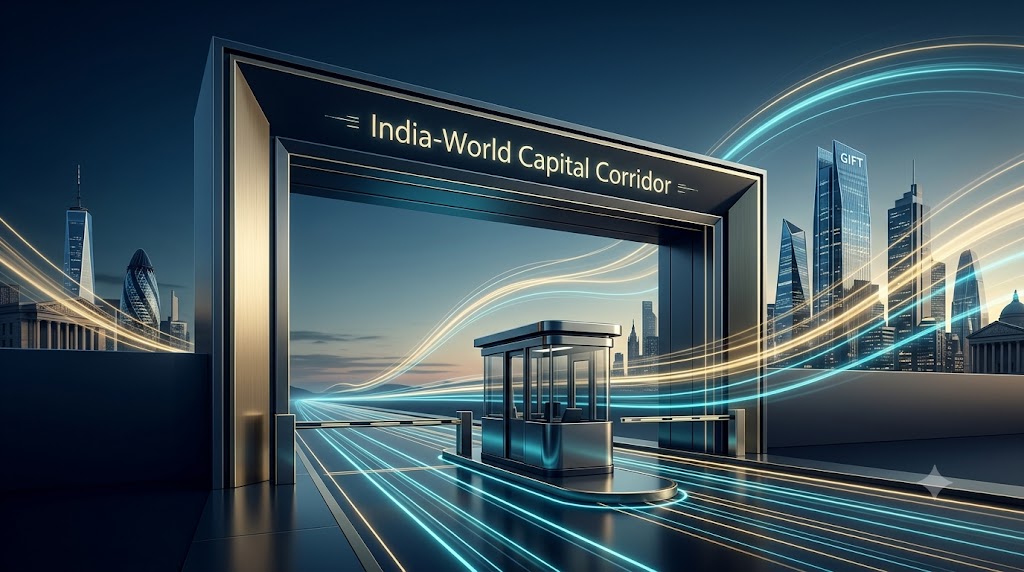
When the world demands what India supplies, trillions enter the gate. When India moves outward to secure its global assets, capital exits the gate. GIFT City is the pipeline, the RBI is the architect, Rajiv Kumar is the sovereign signal, and domestic retail liquidity is the infinite fuel.
HDFC Bank does not need to conquer Wall Street; it just needs to sit at the tollbooth of the Indian economic corridor and collect its piece of the crossing. Dalal Street thinks the bank is a slow-moving utility reaching its final chapters. In reality, the sovereign playbook is treating it like it is just Chapter One.
Disclaimer: This article is strictly for informational and analytical purposes detailing macroeconomic trends and corporate structures. It does not constitute financial, investment, buy, or sell recommendations.