The setup: sales are alive, margins are broken
In cyclical businesses, the best opportunities rarely appear when reported profits look clean. They usually appear when the profit and loss statement looks damaged, retail enthusiasm fades, and the balance sheet quietly survives the storm.
West Coast Paper Mills Limited is currently sitting in that zone.
The headline numbers look weak at first glance. Consolidated net profit has collapsed sharply from the FY23 peak. Operating margins have compressed. Depreciation has increased. CWIP remains elevated. Public quarterly commentary and investor presentation activity have reduced compared to earlier periods.
But the financial statements tell a more important story.
West Coast Paper is not showing signs of a broken business. It is showing signs of a margin cycle bottom, backed by a strong balance sheet and an expanded asset base.
That difference matters.
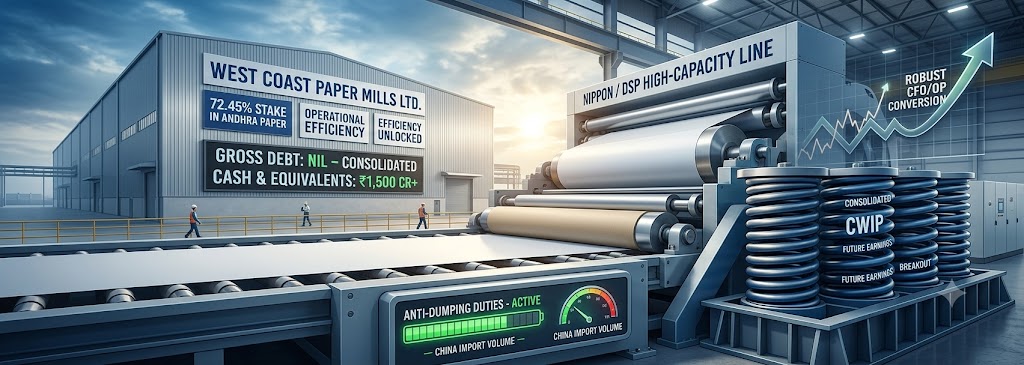
1. FY23 vs FY26: the damage is in margins, not demand
The cleanest way to understand West Coast Paper is to compare FY23, the super-cycle year, with FY26, the current depressed cycle year.
| Metric | FY23 | FY26 | Change |
|---|---|---|---|
| Sales | ₹4,921 cr | ₹4,279 cr | -13% |
| Operating Profit | ₹1,647 cr | ₹413 cr | -75% |
| OPM | 33% | 10% | -23 percentage points |
| Net Profit | ₹1,087 cr | ₹156 cr | -86% |
The important point is simple: sales are down only 13% from the FY23 peak, but operating profit is down 75% and net profit is down 86%.
That means this is not primarily a demand-collapse story. It is a margin-collapse story.
The company is still generating large revenue. The issue is that the spread between selling prices and costs has compressed severely. In the paper industry, this can happen quickly when low-priced imports pressure realisations and raw material costs remain elevated.
That is why simple P/E analysis becomes dangerous at the bottom of a commodity cycle. Earnings often look broken at the exact point where the asset base may be getting stronger.
2. Depreciation is adding pressure, but it is not the main villain
A common mistake in capital-cycle investing is to blame the entire profit collapse on depreciation.
In West Coast Paper’s case, depreciation has definitely increased. It moved from ₹189 cr in FY23 to ₹248 cr in FY26, an increase of 31%.
That matters because depreciation is a non-cash cost. It hits reported profits even though cash does not leave the business in that year. The increase also confirms that past capex has started entering the active fixed asset base.
But depreciation is not the full story.
Operating profit fell by more than ₹1,200 cr between FY23 and FY26, while depreciation increased by ₹59 cr.
So the honest conclusion is this:
Depreciation is adding pressure, but the main earnings killer is the fall in OPM from 33% to 10%.
That makes the thesis cleaner. If margins recover even partially, the earnings rebound can be meaningful because the current profit base is already heavily depressed.
3. CWIP shows West Coast is still in the late asset-build phase
The balance sheet gives the second clue.
| Metric | FY23 | FY26 |
| Fixed Assets | ₹1,659 cr | ₹2,182 cr |
| CWIP | ₹55 cr | ₹290 cr |
Fixed assets have increased meaningfully, from ₹1,659 cr to ₹2,182 cr. That shows a large part of the capex cycle has already moved into the productive asset base.
At the same time, CWIP has increased from ₹55 cr to ₹290 cr. So it would be wrong to say that the entire capex cycle is completely finished.
The better interpretation is this:
West Coast Paper is in the late stage of its asset-build phase. A large part of the asset base has already expanded, visible in higher fixed assets and higher depreciation. But CWIP remains elevated, which means some capital work is still moving through the system.
This is exactly what capital-cycle investors watch for: margins are low, assets are being built, depreciation is already rising, and the market is valuing the business during the painful transition phase.
4. The cash strength is the most important part of the thesis
The strongest argument for West Coast Paper is not just capex. It is the balance sheet.
As of FY26, the company had:
| Metric | FY26 |
| Investments | ₹1,492 cr |
| Borrowings | ₹345 cr |
| Net investment surplus | ~₹1,147 cr |
This is the biggest reason West Coast Paper stands apart from many cyclical industrial companies.
The company is not trying to survive the downturn through heavy leverage. It holds investments far above borrowings. That gives it a large treasury cushion while margins are weak.
This matters because paper cycles can stay painful longer than investors expect. A weak balance sheet can destroy equity value during downturns. A strong balance sheet allows a company to wait.
West Coast Paper’s balance sheet gives it that waiting power.
The correct way to describe this is not “gross debt nil.” The company does have borrowings. The stronger and more accurate point is that investments of ₹1,492 cr are far higher than borrowings of ₹345 cr.
That is the real balance-sheet strength.
5. Cash flow recovery confirms internal discipline
FY25 was a difficult year from a cash-flow perspective. Cash from operating activities fell to ₹99 cr and CFO/Operating Profit conversion dropped to 38%.
FY26 looked much better.
| Metric | FY25 | FY26 |
| CFO | ₹99 cr | ₹400 cr |
| CFO/OP | 38% | 108% |
| Working Capital Change | -₹317 cr | +₹31 cr |
| Inventory Movement | -₹189 cr | +₹68 cr |
This is a major positive.
In FY26, cash from operating activity recovered to ₹400 cr. CFO/OP conversion jumped back to 108%. Inventory released ₹68 cr of cash instead of consuming cash like the previous year.
That means even at a depressed margin level, the business is again converting operating profit into cash.
For a cyclical company, that is important. Earnings are weak, but the cash engine is not dead.
6. Capex is heavy, but intensity is cooling
West Coast Paper has been spending heavily on fixed assets.
| Year | Fixed Assets Purchased |
| FY24 | ₹525 cr |
| FY25 | ₹450 cr |
| FY26 | ₹381 cr |
Over FY24–FY26, fixed asset purchases were around ₹1,356 cr.
That is a large number relative to the company’s current profit base. It also explains why reported earnings look compressed while the balance sheet is building capacity.
But there is one encouraging point: fixed asset purchases have reduced from ₹525 cr in FY24 to ₹381 cr in FY26. Capex intensity appears to be cooling, although elevated CWIP shows the asset-build phase is not fully complete.
This supports the capital-cycle view. The company has gone through heavy asset-building while the industry was under margin pressure. If realisations improve later, the larger asset base could create strong operating leverage.
7. Andhra Paper adds a second operating layer
West Coast Paper should not be viewed only as a standalone paper company.
The company owns a 72.45% stake in Andhra Paper. This makes Andhra Paper a major strategic asset inside the broader West Coast structure.
Andhra Paper went through its own operating pressure during the downturn. That pressure affected consolidated performance.
But from a capital-cycle perspective, the structure is interesting. West Coast has a strong treasury and lower net risk at the parent level, while also holding a controlling stake in a second paper manufacturing business.
If the paper cycle improves, West Coast participates in two ways.
First, through its own manufacturing recovery.
Second, through its ownership in Andhra Paper.
That is why the Andhra stake matters. It adds a second operating layer to the group when the industry cycle turns.
8. DII accumulation and public float reduction are worth tracking
Shareholding behaviour does not guarantee future returns, but it is useful evidence.
Between June 2023 and March 2026, West Coast Paper’s shareholder base changed meaningfully.
| Shareholder Category | June 2023 | March 2026 |
| Promoters | 56.53% | 56.58% |
| DIIs | 7.18% | 13.11% |
| Public | 28.92% | 27.06% |
The key move is in DIIs. Domestic institutional ownership nearly doubled from 7.18% to 13.11%.
Names such as Nippon India Small Cap Fund and DSP Small Cap Fund bring active small-cap exposure. Parag Parikh and HDFC-style value participation add a more stable institutional layer.
Meanwhile, public shareholding reduced from 28.92% to 27.06%.
This does not automatically mean the stock must go up. But it does show that while the reported earnings cycle was weak, domestic institutions were willing to absorb more of the float.
That is usually not random.
9. Government Import Protection: Support for Paperboard Realisations
One of the major headwinds for Indian paperboard companies has been low-priced imports. When imported paperboard sets the lower price benchmark, domestic producers struggle to improve realisations even when demand is stable.
That pressure is now being addressed through policy action.
The first major step is the Minimum Import Price on Virgin Multi-layer Paper Board. Imports below the notified CIF price are restricted, creating a floor against ultra-cheap paperboard imports.
The second step is DGTR action. DGTR has issued final findings in anti-dumping investigations involving Virgin Multi-layer Paperboard from Chile, China PR and Indonesia. There has also been countervailing/anti-subsidy investigation activity involving Multi-layer Paperboard imports from China PR and Indonesia.
For West Coast Paper, this is not a guaranteed profit trigger. It is a realisation support.
If cheap imports stop setting the lower price benchmark, and domestic demand remains stable, even a modest improvement in paperboard realisations can lift margins from the depressed FY26 base.
That is the real importance of government import protection.
10. Demand is showing signs of recovery
The final quarter of FY26 showed a better demand picture.
West Coast Paper’s consolidated quarterly sales for March 2026 stood at ₹1,245.30 cr, up 19.59% year-on-year. Quarterly net profit also improved year-on-year.
That does not confirm a full cycle turn. One quarter is not enough.
But it does show that the business is not facing demand destruction. Volumes and sales are still present. What the company needs now is a better margin environment.
If demand holds, import pressure reduces and raw material costs stabilise, West Coast Paper’s depressed FY26 earnings base can reset quickly.
The final view: clean balance sheet, depressed margins, larger asset base
West Coast Paper is not a simple cheap-stock story.
It is a balance-sheet-supported capital-cycle setup.
The ingredients are visible:
Sales are still meaningful. Operating margins are at a cycle-low level. Depreciation has increased after asset additions. CWIP remains elevated. Cash conversion recovered sharply in FY26. Investments remain far above borrowings. Andhra Paper adds a second operating layer. DII ownership has increased during the weak earnings cycle. Government import protection is creating support for paperboard realisations.
The risks are also clear.
If paper realisations stay weak, input costs remain elevated, or new assets fail to earn adequate returns, the recovery can be delayed.
But the balance sheet gives West Coast Paper time. That is the key.
West Coast Paper has survived the downcycle with cash strength, a larger asset base and rising institutional ownership. If the paper cycle improves even partially, the earnings rebound can be sharp because the FY26 base is already heavily compressed.
That is the real capital-cycle setup.
Disclaimer
The views, analyses and data presented in this article are for informational and educational purposes only. This content does not constitute financial, investment, legal or tax advice. Stock investing involves market risks, and past performance is not indicative of future results. Readers should consult a SEBI-registered financial advisor or conduct independent research before making investment decisions.